
Table of Contents
Sudden drops in website traffic are why many digital marketers have white hair by the time they reach their forties.
The most common causes for sudden traffic drops include, but are not limited to: Google Core Updates, manual penalties, tracking problems, issues with hosting, and general technical issues. Identifying the specific cause usually requires a thorough analysis of analytics and search console data.
Of course, there could be a dozen other reasons why your website visit count has suddenly dropped.
While we’ll go over the most common website problems accompanying traffic drops, it’s important to note that the most crucial skill is your ability to research and understand the problem on your own.
No listicle will have all the answers you need to handle anything Google throws your way.
That said, here is my list of the most common reasons for traffic drops I’ve encountered in my years as an SEO.
Most Common Issues of Sudden Traffic Drops
SEO has always been about gradual improvements. That’s why any sudden changes are red flags that something has dramatically shifted, for better or worse.
If you’re here, it’s because things have taken a turn for the worse. But don’t worry, as the countless hours on Stack Overflow have shown me, your problem isn’t unique. Someone else has faced it before, and hopefully, they’ve found a solution.
Google Algorithm Updates
Google’s algorithm updates are meant to enhance the quality of search results (and shorten the lifespan of digital marketers).
These updates are pivotal, reshaping the rules for content creators and often leading to sudden drops in organic traffic.
Possible Causes
Google rolls out new core updates several times a year. Sometimes, you might not even notice them, as they don’t always aim to overhaul the SERP landscape completely.
However, now and then, an update might catch you off guard and flip your strategy on its head.
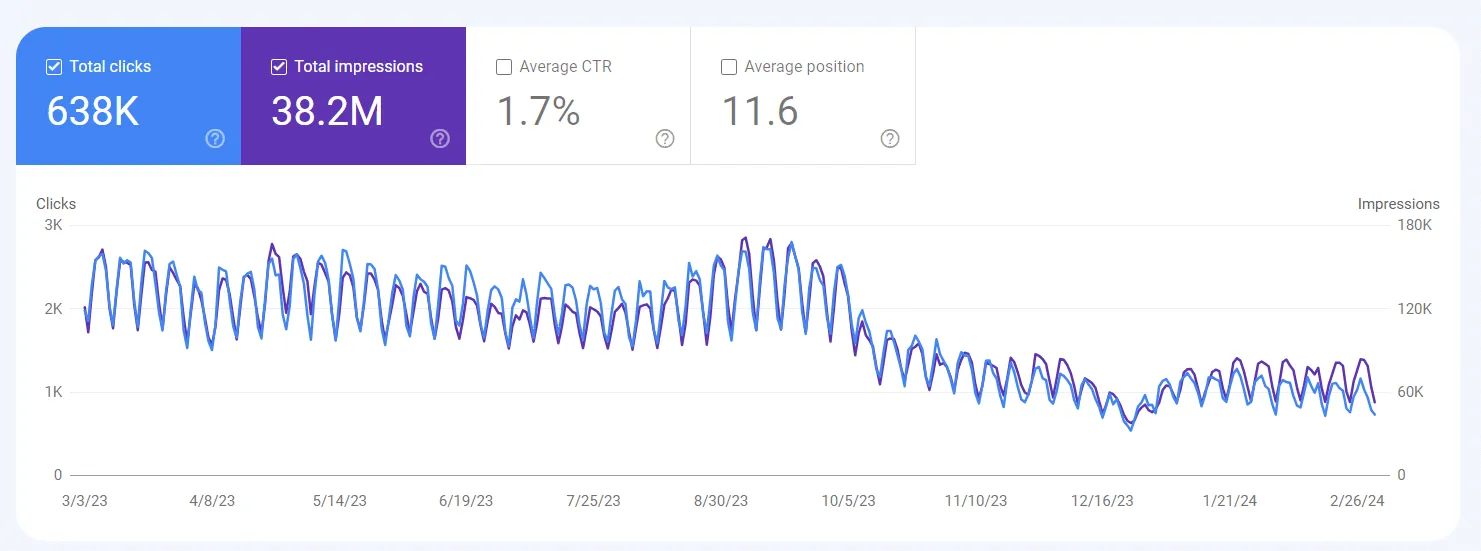 That’s definitely not any of our clients’ sites. We’ve never lost rankings. Right guys? Guys??
This was the case for many websites with the recent Helpful Content Update. Many websites saw a drastic reduction in their usual organic traffic, some up to 40–50%. Since many businesses rely on organic traffic, such abrupt changes are quite disruptive.
How to Fix This
Here are my usual steps when I see a core update has hit a website I manage:
- Pour myself a whiskey.
- Sob quietly.
- Read anything I can find on the subject online.
Each core update is unique, so there’s no one-size-fits-all solution. The best approach is to understand why the affected website has suddenly dropped off Google’s BFF list.
 And Google, just like the popular girl at high school, keeps notes.
Start by reviewing Google’s official documentation on ranking factors. Pay additional attention to any recent updates. Apply this information to your site’s specific context.
Next, consult leading SEO blogs for their take on the update. This will help you gauge the broader implications and adjust your strategy accordingly. Search Engine Land and Search Engine Journal (SEOers aren’t very good with cool and original names) are my go to places for news in the industry.
Typically, issues relate to your site’s quality, the credibility of your content, the relevance of your topics, and the cleanliness of your backlink profile. Aligning your SEO strategy with Google’s updated preferences is critical.
Generally, each drop after a core update requires a different strategy. However, I do have a “panic” list that I reference, which goes something like this:
- Improve Core Web Vitals: A faster site is always better.
- Enhance Authority: E-E-A-T is the boogeyman of SEO, dividing people into non-believers and true-followers. However, showcasing your or your writers’ expertise will always make a difference, even if it’s just for the sake of the user.
- Analyze Individual Pages: Remember, a drop after an update isn’t a penalty; it’s just Google changing its preferences. Adjust your content to meet Google’s new standards.
Important note: SEO success requires consistency. Improvements might not lead to immediate results. Once Google switches you to the unpopular group of kids, it takes a whole new Google core update to go back to the cool ones. Be prepared and keep refining your website. Because Prom day will come, and you want to bring your A-game to it.
Manual Penalties
A Google Manual Penalty is a manual action that reduces or entirely removes your presence on Google’s Search Results Pages (SERPs).
 You’re out!
Google doesn’t hand these out for just anything. You’ve got to really step over the line, violating their Search Essentials (or Webmaster Guidelines, for those who’ve been around a bit longer).
Possible Causes
Have you ever:
- Bought a bunch of backlinks from Fiverr?
- Crawled a dead website and stole its content?
- Published thousands of templated new pages with little to no original content?
- Hidden “best SEO services” as white text on a white background?
- Linked a bunch of your sites together to try and game the system?
- Made any other malicious acts of black hat SEOery?
If so, you may be entitled to a free Manual Penalty!
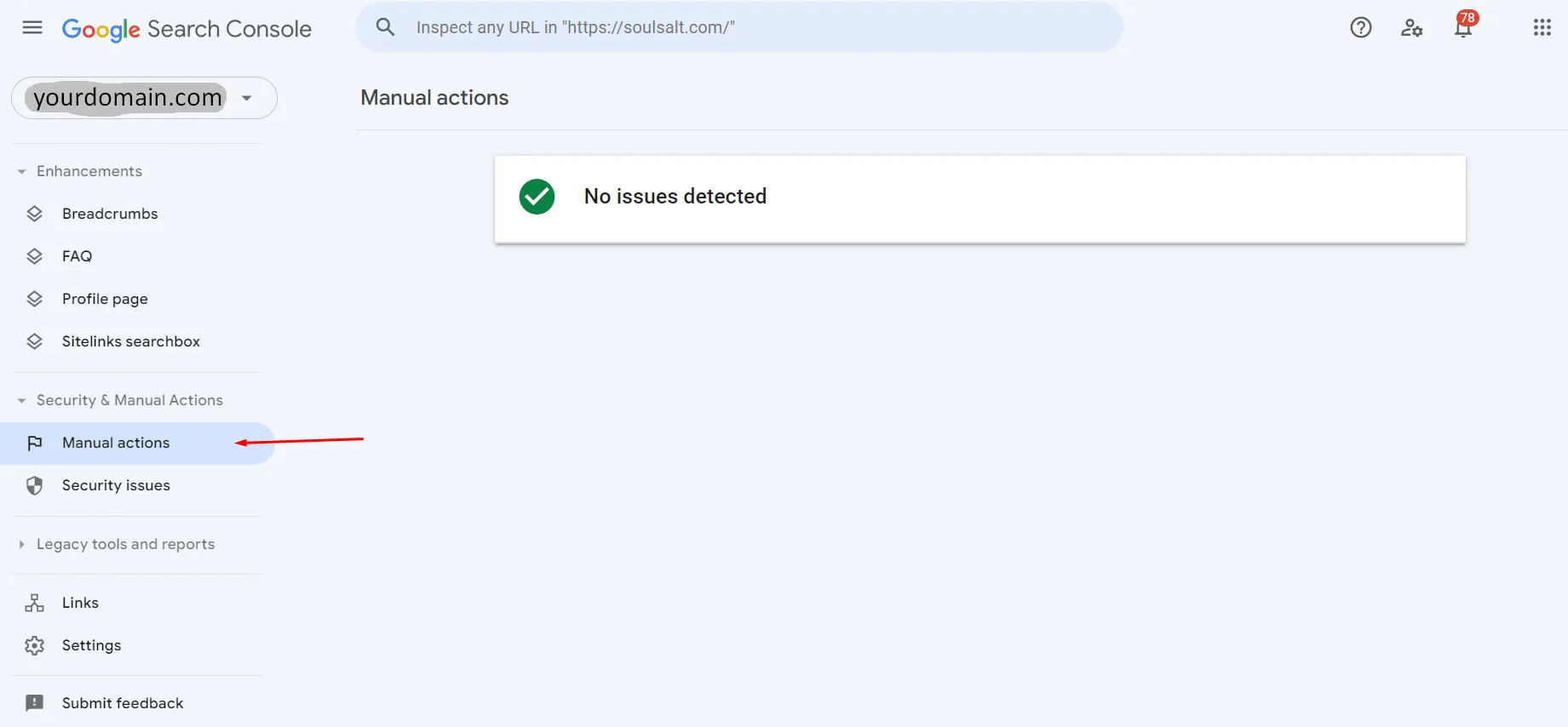 I pray to the internet gods (god…there’s only one internet god) that your Search Console always looks like this.
Let’s face it. If you’ve got one of those messages, you probably know what you did! But hey, don’t feel bad. Google has no moral authority. You tried your best to game the system and failed. We all make mistakes.
“Forgive, and you shall be forgiven…”
How to Fix This
Google might be strict, but they’re also fair. Here’s the lowdown on what to do to get back in their good graces:
1. Head over to your Search Console and open the manual action report to see what the issue is.
2. Identify which pages are affected.
3. You’ll find a brief explanation of the problem and a “Learn more” link. Click that for a detailed breakdown and instructions on how to fix it.
4. Now, roll up your sleeves and fix those issues on every affected page. Fixing a few won’t cut it, and you won’t get any brownie points or partial comebacks in search results. Do you have more than one manual action? Tackle them all.
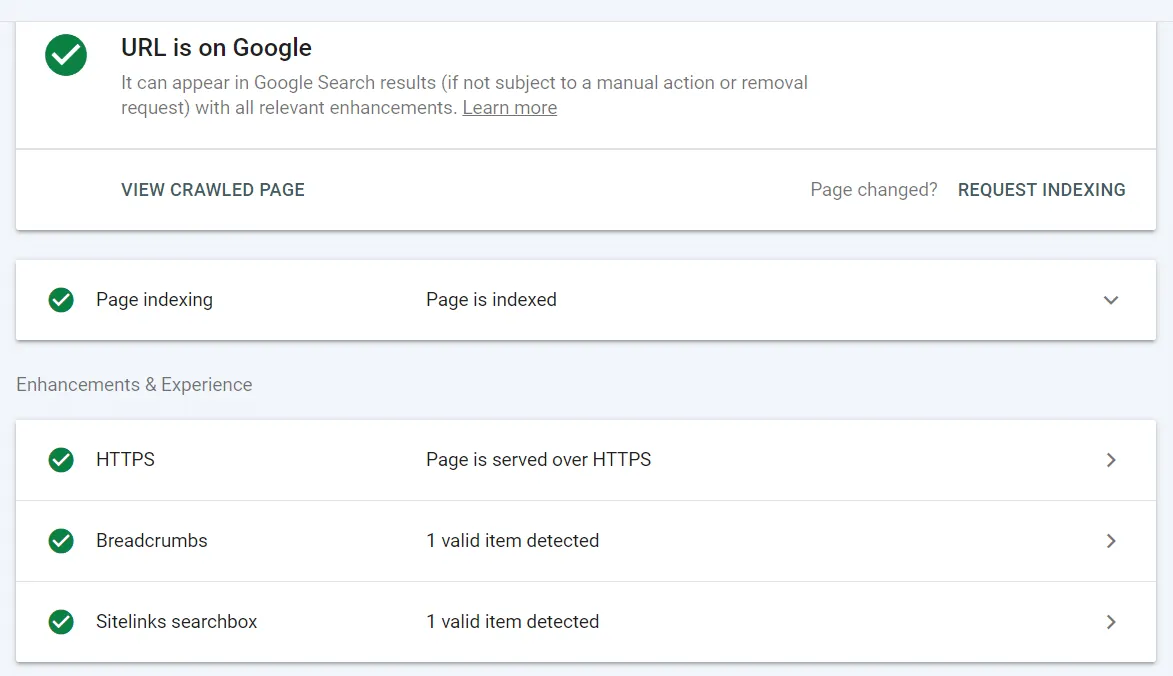
5. Make sure Google can crawl your pages. A login, a paywall, robots.txt, or a noindex directive shouldn’t block them. Use the URL Inspection tool to double-check that Google can access them.
6. Once you’ve made your fixes, hit “Request Review” on the report. When you ask for reconsideration, make sure to:
- Spell out the exact problem you found on your site.
- Explain what you did to fix it.
- Show off the results of your hard work.
Patience is key, as the review process can take some time. You’ll get updates by email, so there’s no need to keep resubmitting your request. Just sit tight and pray.
Remember, getting a manual penalty isn’t the end of the world. It’s a wake-up call to clean up your SEO act and get back on the right track.
Tracking Issues
We often overlook that a website operates like its own little ecosystem, with various digital creatures playing their role. SEOs don’t work in a vacuum and people with different backgrounds poke here and there constantly.
When a drop isn’t a drop?
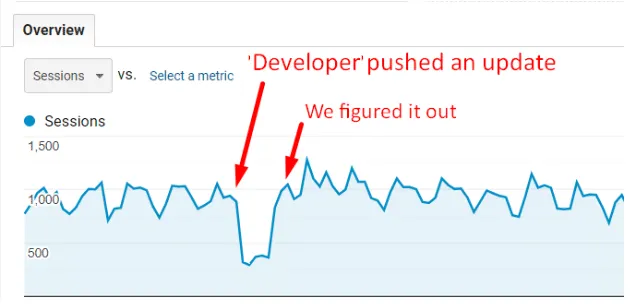 When someone f%$ks up the tracking code!
It might be the developers, it might be the editors, it might be you (still blame the developers). But every so often, a tracking tag gets deleted, and you’re left with a hole in your graph like the image above.
Possible Causes
Anyone but you! These glitches most often occur during site redesigns, migrations, or platform updates. If you use third-party plugins for your tracking code, tread carefully with updates. And if you’re a Google Tag Manager user, keep a sharp eye on those updates.
It’s all about keeping your website tidy and ensuring that anyone with access also keeps things clean.
How to Fix This
Thankfully, this problem doesn’t mean your traffic has vanished. It’s just a loss of data and an uncomfortable Monthly Report for a client. All you need to do is return the tracking code, and data collection will resume. You will have an irreversible loss of data, but if you do regular checks, it will be small and insignificant.
To tackle this issue, it’s more about vigilant monitoring than anything else. Some preventative measures include:
- Weekly checks on your analytics tools
- Checklists after any significant backend changes
- Using a staging server before any new deployments
Keeping a close eye on things can help prevent significant data loss and keep your digital ecosystem thriving.
Changes in SERP Layout
Have you ever thought Google’s SERP layout is more unpredictable than a cat on catnip? That’s because it is.
One day, you’re comfortably sitting at the top, plundering the traffic with your Featured Snippet result, and the next, you’re pushed down by a flurry of Reddit posts, YouTube videos, and who knows what else. It’s like Google is the DJ, and you’re dancing to its tunes, except the music changes without warning.
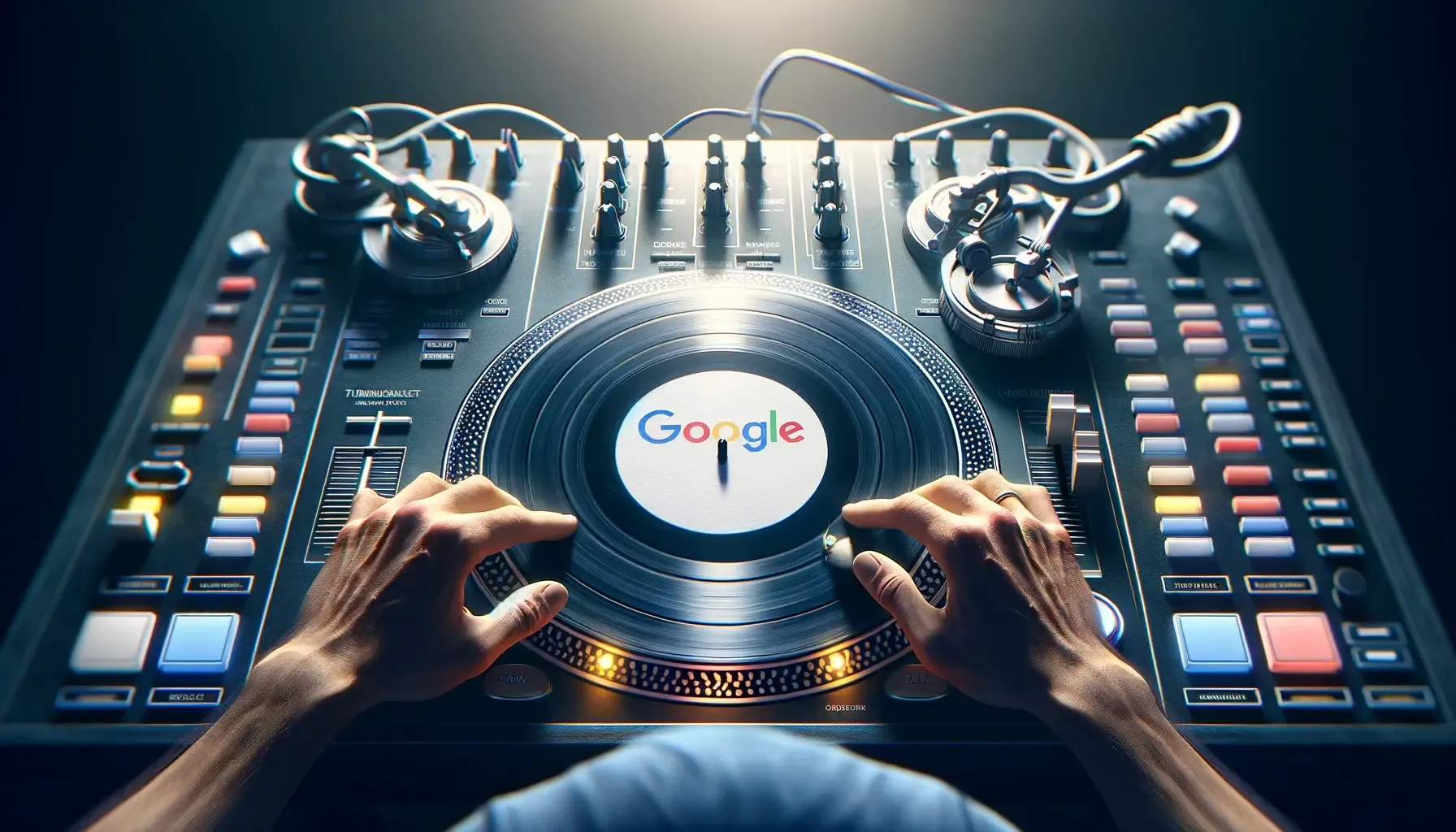 DJ Big G dropping a new update on the unsuspecting crowd
Possible Causes
Google loves shaking things up. These changes in SERP layout are meant to enhance user experience but often at the expense of your organic listing’s visibility.
Whether it’s a new featured snippet box or a direct answer that negates the need to click through, these adjustments can significantly impact your traffic. The world is evolving, and you can either sink or swim.
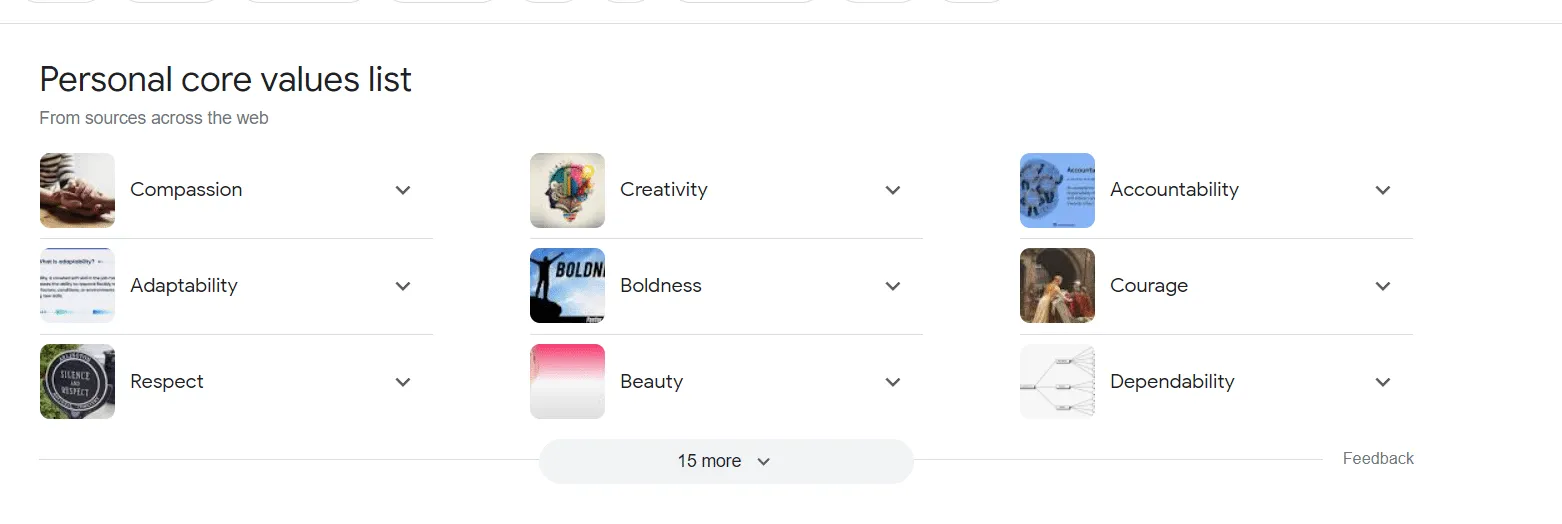 A high-value featured snippet of our client got replaced by Google’s native widget.
How to Fix This
Adapting to Google’s ever-changing SERP layout requires a mix of SEO-savvy and a dash of creativity. Start by targeting featured snippet opportunities. Think of it as becoming the teacher’s pet; you’ve got to give Google exactly what it wants.
Essentially, you need to play Google’s game by focusing on quality content that answers questions directly, and maybe, just maybe, you’ll find yourself back in the spotlight. Remember, you were already there, so it belongs to you and you alone! IT IS YOUR BIRTHRIGHT!
Crawling Issues
Imagine your website as the top place to hang in the mall. Whether to chat with friends, read a cool book, or buy the latest Nikes, this place is always packed with traffic!
Now, what if your store’s entry door jammed and couldn’t open anymore? Some people will still find their way inside, but Googlebot is all about principles. He’ll simply stop visiting. And he surely won’t tell his friends about you if he stops visiting.
Possible Causes
Crawling issues often stem from the digital equivalent of putting a “Do Not Enter” sign on your door. This could be due to a misconfigured robots.txt file, a website structure more complex than a Rubik’s Cube, or server errors that greet Googlebot with a cold shoulder instead of a warm welcome.
Back in the day, I would love to blame developers for creating JavaScript backlinks instead of using the old faithful tag, but today, Google’s smarter than that and can crawl JS-rendered websites. Or so we think …
How to Fix This
I can’t stress this enough: HAVING CRAWLING ISSUES IS A HUGE PROBLEM AND IT MIGHT KILL ALL YOUR RANKINGS.
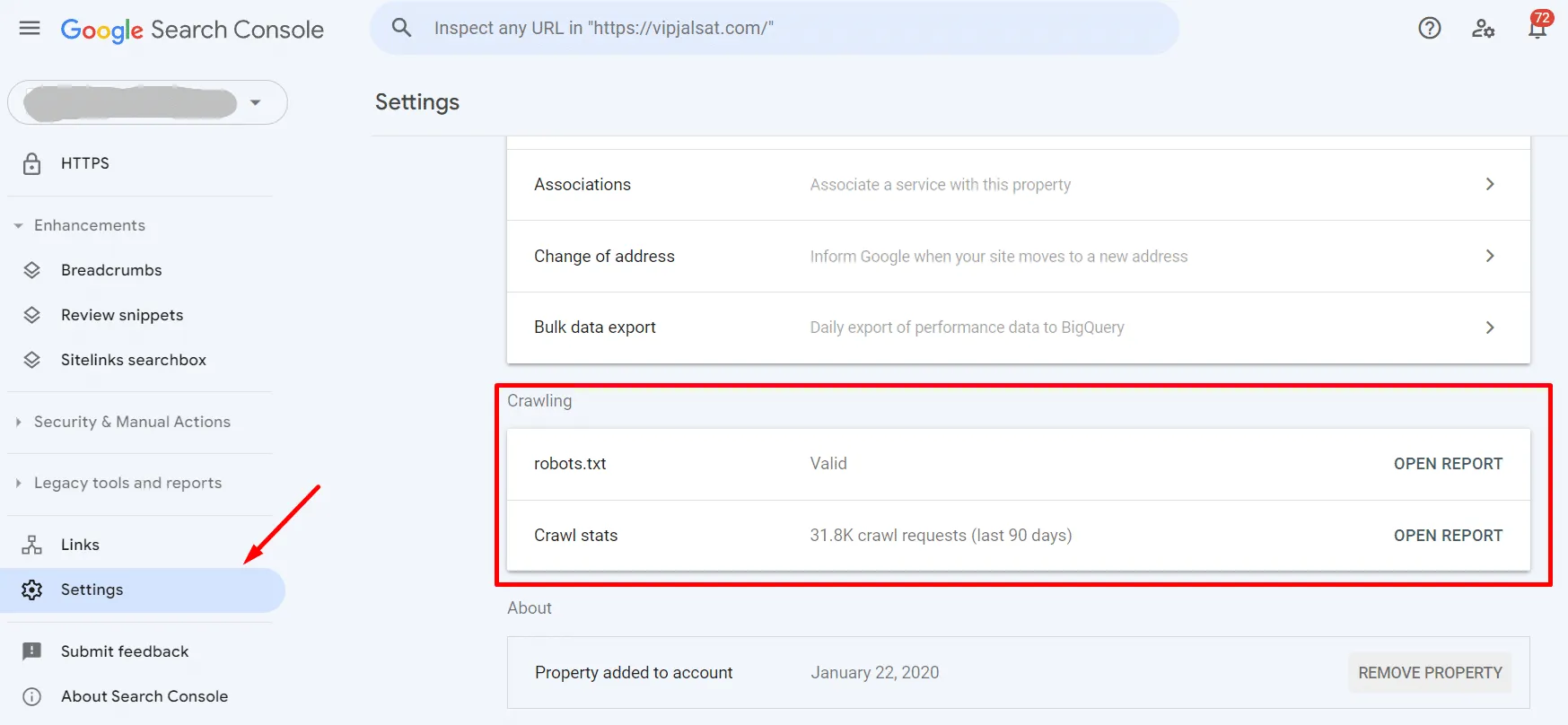 My best friends in GSC. Some days.. my only friends :(
So make sure your site is crawlable.
- Monitor your Google Search Console. It’s your best friend and will tell you precisely what Google wants to say about your website and its issues.
- Use a website crawler, like Screaming Frog or Xenu, to see if your website is easily crawled. If your website isn’t a basic WordPress blog, make sure to set up the JS settings.
- Configure your robots.txt file correctly. Several online validators will help you translate the symbols inside it.
- Check the server logs for any issues related to the hosting provider. Most of the time, serving 500 status code pages to Google will count as a crawl issue.
Indexation Issues
Being invisible might be a cool superpower in comic books, but in the world of SEO, it’s your worst nightmare. Indexation issues are like being at a party stuck in a cloak of invisibility; you’re there, but nobody knows it. And if Google can’t see you, neither can your audience.
 Yes, I’m the heart of every party.
Possible Causes
Indexation problems can arise for several reasons, both being technical or Google being an ass. Most often, they appear because:
- Accidental noindex tag on a number of your pages. This could happen after a migration or a CMS update when using a staging server. It happens more often than any professional will admit.
- Incomplete Sitemap. Although Google is supposed to still crawl and index your pages, not helping it with a properly working sitemap doesn’t give you pro points.
- Duplicate content. Google doesn’t like to read the same thing twice, nor does it like giving visibility to the same content twice.
- Canonical Issues. The meta canonical tag can have the power of Excalibur if wielded by the right hands. It can also stick you in the foot if you don’t know what you are doing.
How to Fix This
Solving indexation issues is akin to launching a visibility campaign. Start by ensuring your sitemap is as current as today’s news and accessible as a public park.
- Use the “site:” search command to conduct a roll call of your pages in Google’s index.
- Remove those pesky noindex tags you might have placed during a late-night website update session.
- Make sure your content is as unique as a snowflake.
- Use the Inspect any URL tool in your GSC and listen to what else Google has to say
How to Analyze Drops in Traffic
It’s important to remember downfalls happen to the best of us. Sooner or later, it could happen to you. And you have to remember the most important mantra a person can have:
DON’T PANIC!!!
Diagnosing a drop in website traffic is less about looking for a needle in a haystack and more like playing detective in a mystery novel where you’re both the sleuth and the narrator.
To solve the mystery of the disappearing clicks, you must channel your inner Sherlock Holmes. You need a mindset that’s curious, analytical, and a tad obsessive about details. Your approach should be systematic yet creative and ready to connect dots that aren’t necessarily linear.
Remember, every website’s drop in traffic is a story unique unto itself, with twists, turns, and the occasional red herring.
 Elementary, my dear Watson, the missing clicks are with the competition…
Start with the Scene of the ‘Crime’
Begin where the action happens: your analytics. A sudden drop in traffic isn’t just a number; it’s a symptom. Your analytics are the crime scene, providing the initial clues. Dive deep. Look at the timing of the drop. Was it sudden or gradual? This can hint at whether you’re dealing with a technical glitch, a penalty, or a change in user behavior.
Examine All the Suspects
Was there a recent Google update? Is there a new competitor on the block stealing your spotlight? Did some intern accidentally disinvite Google from crawling your site with a mischievous robots.txt update? Or maybe, just maybe, your content has gone stale like last week’s bread. Leave no stone unturned and no suspect unchecked.
Check Your Alibis
Your alibi in this mystery is your recent activity log. Have you made changes to the site? Launched a new redesign? Perhaps you redirected some pages?
Every action has a reaction, and in the digital world, some of these reactions result in traffic drops. Document these changes meticulously as if preparing for a court case. This log is your alibi, your chance to correlate actions with outcomes.
Interrogate Your Witnesses
Witnesses in this scenario are your tools and reports. Your key witnesses are Google Search Console, Analytics, backlink checkers, and even social media analytics.
Interrogate them with precision. Look for crawl errors, page speeds, backlink losses, and social engagement. Each tool has a story to tell, a piece of the puzzle that can help you understand the bigger picture.
Stay Rational, Not Emotional
Approach every finding with a hypothesis-testing mindset. If you think a broken redirect is the culprit, test it. If you suspect content quality, analyze your engagement metrics. Be willing to accept or reject your hypotheses based on evidence, not gut feelings.
Remember, figuring out why your website traffic dropped is more of a marathon than a sprint. It requires patience, persistence, and a bit of detective work. You might not solve the mystery overnight, but you’ll uncover the truth with a methodical approach. And in the world of SEO, truth is the first step towards redemption.
Reviving a Website That’s Losing Traffic Can Be Hard
Not every mystery can be solved. Sometimes, things get too tricky, or you just can’t figure it out alone. Even Sherlock Holmes sometimes needed a little help from his friends at Scotland Yard. Having a digital agency to support you can save you a lot of stress and gray hair.
At Digital Commerce Partners, we’ve experienced many of these challenges before, so we’re usually one step ahead.
More importantly, we know how to avoid those big drops in traffic in the first place. And isn’t it better to stop a problem before it starts than to fix it after it’s happened?
If you want peace of mind from a team that knows the ins and outs of the internet, click the link below to get in touch with us today.