
Table of Contents
The keyword research most ecommerce stores do is broken. Not wrong. Broken.
They open Ahrefs, type in a seed keyword, sort by volume, and start assigning terms to pages. The process produces a spreadsheet. It doesn’t generate revenue.
Here’s the problem: traditional keyword tools tell you what people type. They don’t tell you why, what page type the searcher expects, or whether your brand shows up on both surfaces where buyers now search: Google organic and AI platforms like ChatGPT, Perplexity, and Claude.
Same Brand, Two Surfaces, Completely Different Visibility
We ran an analysis on YETI across Google organic and AI search. Four keywords in the same product category. Same brand. Same catalog. On Google, all four keywords return YETI in the top results. On AI platforms, the picture fractures.
“Best soft cooler” (2,900 monthly searches): YETI recommended across ChatGPT, Claude, and Perplexity. Google rankings and AI visibility aligned.
“Best cooler for beach” (1,900 monthly searches): YETI ranks on Google, but disappeared from two of three AI platforms. Claude recommended Pelican, Coleman, and Lifetime instead. ChatGPT didn’t mention any cooler brand at all.
Same product. Same brand. Google says you’re visible. AI search says you don’t exist. A volume-and-difficulty spreadsheet doesn’t show you the gap between these two surfaces.
This guide covers the keyword research process that actually accounts for this. Buyer jobs, page-type alignment, LLM validation, and the architecture that turns research into rankings across every surface where your customers search.
Keywords Are Buyer Jobs, Not Search Volume
Standard keyword research groups terms by volume and difficulty. Ecommerce keyword research groups terms by what the buyer is trying to accomplish.
A buyer searching “best cooler for camping” and a buyer searching “best soft cooler” are in the same product category. A traditional keyword tool would tell you both are low difficulty, both have decent volume, and both should probably point at your cooler collection page.
That analysis misses everything that matters.
- The camping buyer has a use-case constraint. They need ice retention for three days. They’re comparing hard-sided coolers by capacity and durability.
- The soft cooler buyer has a form-factor constraint. They want something portable, packable, probably for day trips.
Different products, different collection pages, different content, different competitors showing up in the conversation.
We call these buyer jobs, borrowed from Clayton Christensen’s Jobs to Be Done framework. Each keyword represents a job the buyer is hiring your content to do. Group keywords by the job, not the product.
| Buyer Job | Keyword | Volume | What They Need |
|---|---|---|---|
| Camping trip prep | best cooler for camping | 880 | Ice retention, capacity, durability comparisons |
| Portable day use | best soft cooler | 2,900 | Packability, weight, leak-proof, lifestyle fit |
| Budget shopping | yeti alternative | 1,000 | Price comparisons, value breakdown, similar performance |
| Beach trip prep | best cooler for beach | 1,900 | Sand resistance, portability, UV, corrosion |
Each of these buyer jobs requires its own page. Cramming all four into one generic “coolers” collection page means ranking for none of them well while a competitor with dedicated pages for each job takes the traffic.
Intent Still Matters, but It’s Not Enough
Every keyword research guide tells you to filter by intent. Informational, commercial, transactional. That framework is useful but incomplete.
Two commercial-intent keywords can require completely different page architectures. “Best cooler for camping” and “yeti alternative” are both commercial investigation queries. But the camping query needs a use-case buying guide. The alternative query needs a comparison page with pricing. Same intent label, different buyer job, different page type.
Filter by intent first. Then ask: what job is this keyword hiring my page to do?
Collection Pages First, Everything Else Second
Once you’ve mapped buyer jobs, the question is where each keyword lives.
Most ecommerce stores get this backwards. They pour keyword research into blog posts while the pages that actually generate revenue sit unoptimized on page three.
The priority order:
Collection Pages Capture Category Search
Collection pages rank for how buyers search a product category. They capture the broadest commercial intent and drive the most organic revenue per page.
Assign each collection page one primary keyword and three to five secondary keywords that map to the same buyer job:
| Collection Page | Primary Keyword | Secondary Keywords |
|---|---|---|
| /hard-coolers | best hard cooler | hard sided cooler, rotomolded cooler, ice chest |
| /soft-coolers | best soft cooler | soft sided cooler, portable cooler bag, insulated cooler bag |
| /coolers-for-camping | best cooler for camping | camping cooler, 3 day cooler, cooler for car camping |
Each row is a distinct buyer job with its own primary and secondary keywords.
Product Pages Convert the Final Click
Product pages target the highest-intent keywords: exact product names, model numbers, and specifications. Someone searching “YETI Tundra 45” has already decided. Your job is to be where they click.
Product keywords have lower search volume but convert at two to three times the rate of collection-level terms. Target:
- The exact product name
- Model number
- One or two key specs that differentiate (size, color, material)
Landing Pages and Buying Guides Fill Gaps
Landing pages and buying guides capture commercial investigation queries that don’t map cleanly to a collection. “Best cooler for beach” might warrant its own landing page if your collection structure doesn’t cover it naturally.
Build these strategically. Three well-targeted landing pages built around specific buyer jobs will outperform thirty generic buying guides that cover the same ground.
How to Do Ecommerce Keyword Research: Step by Step
Step 1: Mine Your Customer Language First
The most valuable keyword insights come from the words your buyers already use. Not from a keyword tool.
- Product reviews. Read your reviews and your competitors’. Recurring phrases like “kept ice for four days in 90-degree heat” map directly to buyer-job keywords. Amazon reviews surface language your customers use that keyword tools never suggest.
- Support tickets and pre-sale questions. “Do you have a cooler that fits under an airplane seat?” tells you exactly how that buyer would search.
- Site search data. What visitors type into your search bar are keywords they expected to find and couldn’t. These are collection pages you haven’t built yet.
Use this real language to seed your keyword tool. Plug the phrases into Ahrefs, Semrush, or whichever platform your team runs and expand from there. Also check Google Autocomplete (type your product + “for…” or “vs…”) and People Also Ask.
Step 2: Group by Buyer Job, Not by Product
This is where most keyword research falls apart. Stores group keywords by product type and assign them to existing pages. That’s backwards.
Group by the buyer’s constraint first. Then decide which page serves that constraint.
Pull your full keyword list and ask for each term: what job is the buyer hiring this keyword to do?
- Are they comparing options within a category?
- Solving a specific use case?
- Shopping on a budget?
- Looking for a specific product?
Keywords with the same job go to the same page, even if the products overlap. “Best cooler for camping” and “3-day cooler” serve the same job and belong on the same collection page. “Best soft cooler” serves a different job and needs its own page, even though some products appear in both.
Step 3: Assign Every Page a Primary Keyword
Every page on your store gets exactly one primary keyword. No overlap. No two pages competing for the same term.
This is keyword mapping, and skipping it is the fastest way to create cannibalization problems that take months to untangle.
Build your keyword map. List every collection, product, and landing page. Assign a primary keyword to each. Check it before you optimize any page and before you create a new one.
| Page | Buyer Job | Primary Keyword |
|---|---|---|
| /hard-coolers | Durability/capacity buyer | best hard cooler |
| /soft-coolers | Portability buyer | best soft cooler |
| /coolers-for-camping | Camping trip prep | best cooler for camping |
| /yeti-tundra-45 | Product buyer | YETI Tundra 45 |
If two pages target the same primary keyword, one needs to go. Consolidate, redirect, or reassign. Every case of keyword cannibalization splits your authority and confuses both Google and AI search about which page to surface.
Step 4: Expand with Secondary Keywords
Add three to five secondary keywords per page. These are variations that serve the same buyer job, specific product attributes, and related transactional searches.
For the “best cooler for camping” page, secondary keywords might include:
- “camping cooler”
- “cooler for car camping”
- “3-day cooler”
- “cooler with wheels for camping”
Secondary keywords also guide content depth:
- Multiple “how cold does it stay” searches? Add an ice retention comparison section to that collection page.
- Popular “cooler vs” queries? Add a comparison table.
- Recurring “cooler for [specific trip type]” variations? Those might justify a dedicated landing page.
Step 5: Analyze Competitor Gaps Across Two Surfaces
This is where keyword research has changed.
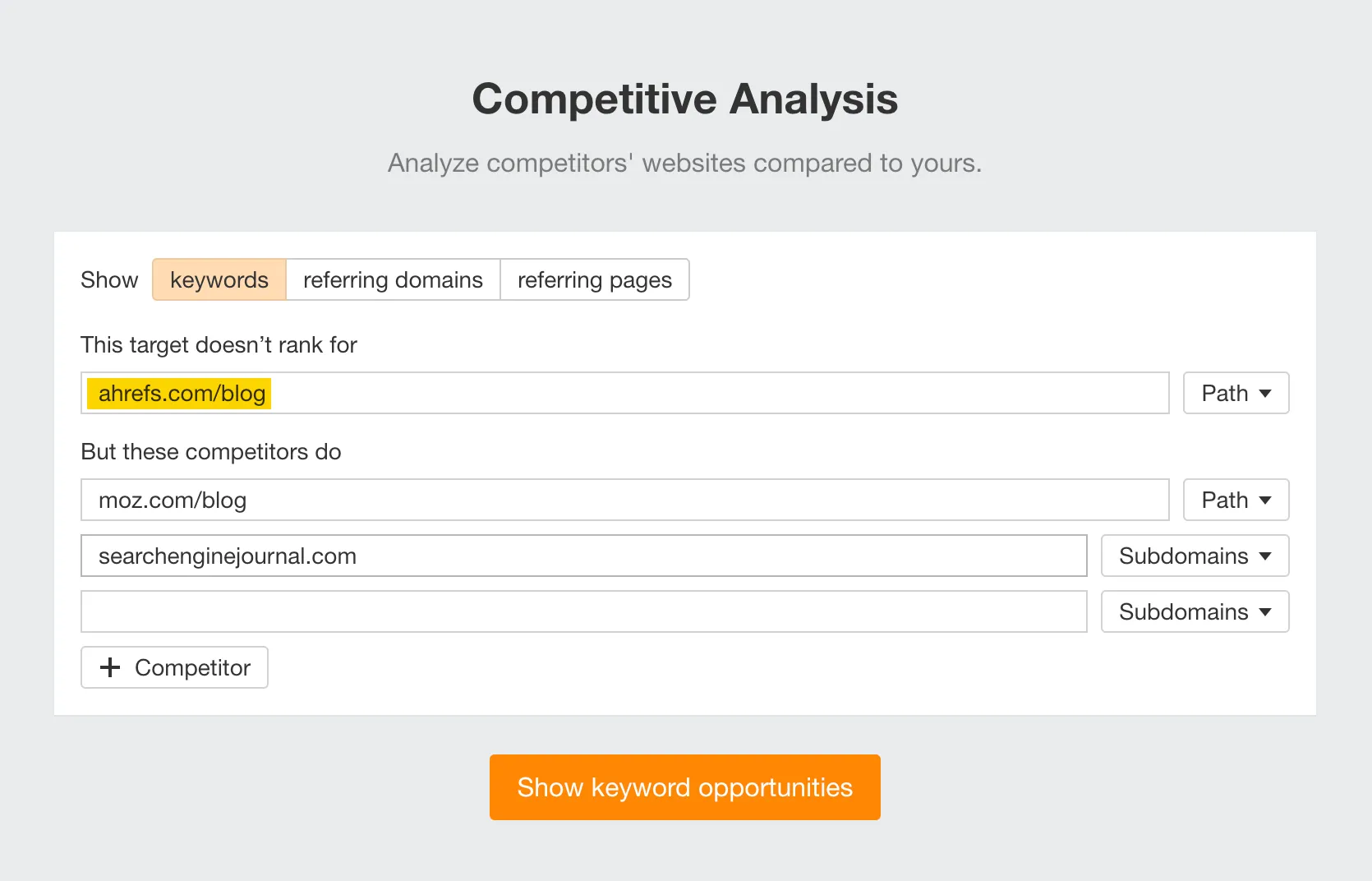
Traditional gap analysis means running your domain against competitors in Ahrefs Content Gap or Semrush Keyword Gap to find terms they rank for that you don’t. That still matters. Do it. Filter the results to their collection pages. That’s where their revenue keywords are, not buried in blog content.
The new layer is AI search.
When we mapped YETI’s visibility across ChatGPT, Claude, and Perplexity, the competitor landscape looked nothing like what you’d see in Ahrefs:
- RTIC appeared in 23 of 36 AI responses
- Coleman appeared in 20
- Both brands show up in LLM answers at a rate far higher than their organic ranking positions would suggest
The citation sources tell the same story. Of 78 total Perplexity citations across all queries:
- OutdoorGearLab was cited 9 times
- Treeline Review was cited 7 times
- CleverHiker was cited 5 times
- YETI’s own site was cited only 3 times, and only on their /coolers hub page and a buying guide
What this means for your keyword research: the competitors you’re benchmarking in Ahrefs may not be the competitors showing up in AI answers. And the content formats earning citations in AI search are category-structured editorial pages, not product pages.
Step 6: Validate Keywords Against AI Search
Before you finalize your keyword map, test your highest-priority keywords in ChatGPT, Perplexity, and Claude. Ask the question a buyer would actually ask.
Don’t type in the keyword. Type in the question behind the keyword:
| Keyword | What to Ask the LLM |
|---|---|
| best cooler for camping | ”I’m planning a 3-day camping trip and need to keep food cold the whole time. What should I look for?“ |
| best soft cooler | ”I need a portable cooler for day trips and hikes. What are my options?“ |
| yeti alternative | ”YETI coolers are too expensive for me. What brands offer similar quality for less?” |
For each response, check three things:
- Is your brand mentioned? If not, you have a visibility gap that content alone won’t fix.
- Which competitors appear? This is your AI competitive set, and it’s often different from your SERP competitive set.
- What sources are cited? In Perplexity especially, cited sources tell you which content formats and domains are feeding AI answers for that keyword.
If your brand shows up for “best soft cooler” but disappears for “best cooler for beach,” that tells you exactly where to invest. The invisible keyword is where your organic gap and your AI gap overlap.
Step 7: Plan for Seasonal Peaks
Search engines and AI systems both need time to process and rank new pages. Optimize two to three months before the season hits.
Use Google Trends to identify when volume spikes, then work backwards:
- Summer gear: Optimize February, promote April through August
- Holiday gifts: Optimize August, promote October through December
- Back to school: Optimize May, promote July through September
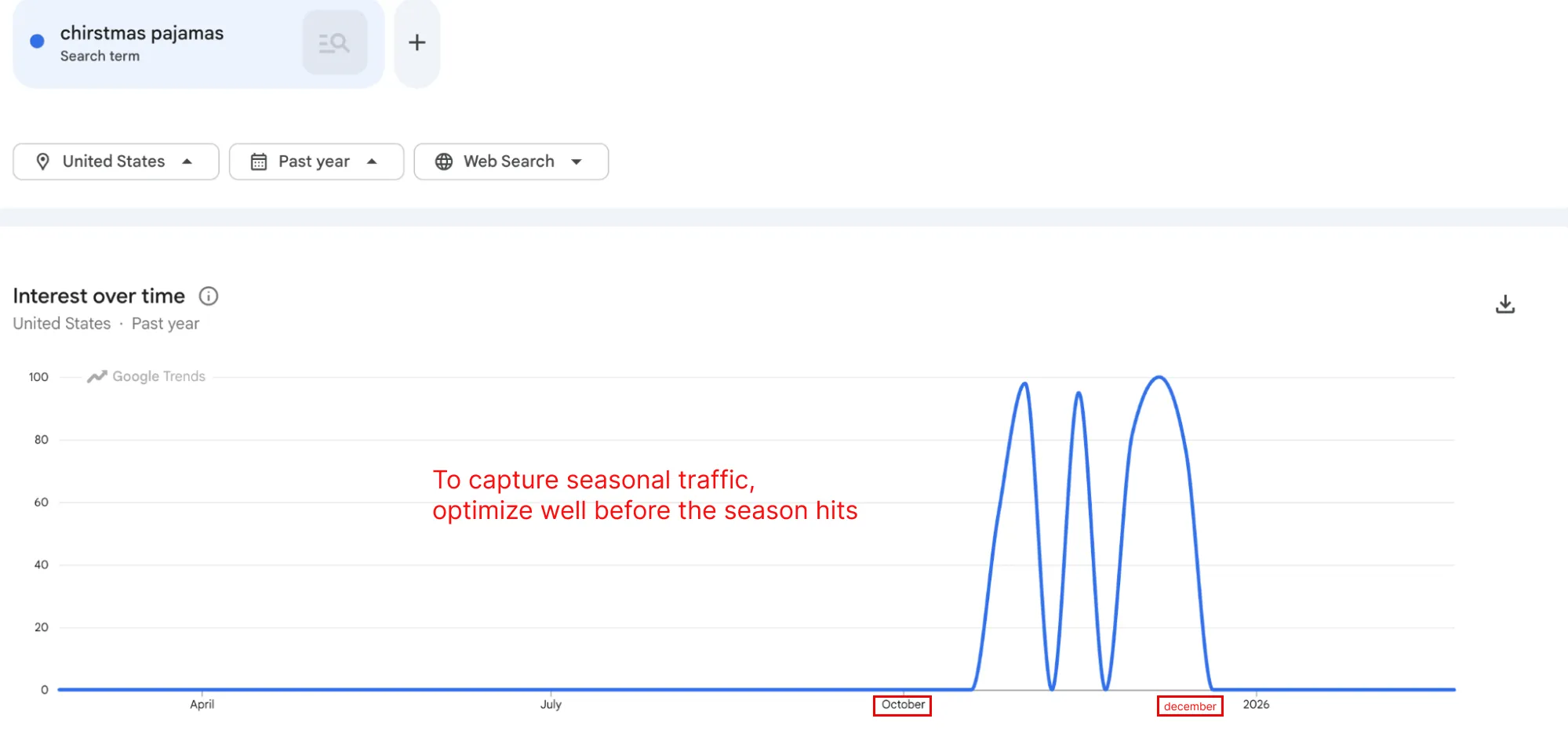
A page published in June for a July peak will not mature in time. The stores that capture seasonal traffic plan their keyword calendar a full quarter ahead.
Mistakes That Cost Revenue
Chasing Volume You Can’t Win
“Cooler” gets hundreds of thousands of monthly searches and is owned by YETI, Amazon, and Walmart. You’re not ranking there.
“Best rotomolded cooler for car camping” gets 400 monthly searches and every person searching it is a buyer with a specific constraint and money to spend.
The math: 400 targeted visitors at 4% conversion equals 16 sales per month from a single long-tail keyword. Build a portfolio of 50 of these and you have a revenue engine. A practical split:
- 60% low-competition keywords for steady conversions
- 30% medium-competition for growth
- 10% high-volume aspirational targets you build toward over time
Ignoring Page-Type Alignment
Optimizing a blog post for “buy hard cooler” is an intent mismatch. The searcher wants products and prices, not a 2,000-word guide.
Before targeting any keyword, search it in Google and look at what’s ranking. If the top ten results are all collection pages, your blog post will not break in. If the results are a mix of buying guides and collections, you need a page structure that matches the dominant format.
This applies to AI search too. LLMs surface product recommendations for transactional queries and editorial content for research queries. Mismatched page types get skipped in both channels.
Mapping Keywords Without Checking AI Visibility
This is the new mistake. Your keyword map looks complete. Google positions improve. But nobody tested whether AI search surfaces your brand for those same terms.
Step 6 exists to catch this. Skip it and you risk investing months building a page that ranks on Google but is invisible on the fastest-growing search surface.
The Gap Between Research and Revenue
Most keyword research ends with a spreadsheet. The process we’ve outlined here doesn’t.
Buyer jobs give you the page architecture. Two-surface validation tells you where you’re visible and where you’re not. The YETI analysis showed what this looks like in practice: a brand that owns Google for every cooler keyword but disappears from AI search the moment the buyer’s constraint shifts.
That gap between organic rankings and AI visibility is where revenue is leaking for ecommerce brands right now. Finding it requires a different kind of keyword research than what most teams are running.
At Digital Commerce Partners, this is what we build: keyword strategies that connect to revenue across both Google and AI search. Not keyword reports. Not spreadsheets.
Common Questions
Frequently Asked Questions
Ecommerce keyword research identifies the search terms buyers use when they're ready to purchase and maps those terms to the right page types. Unlike standard keyword research that optimizes for traffic, ecommerce keyword research optimizes for revenue by prioritizing collection and product page keywords over informational blog content.
Traditional keyword tools show volume and ranking difficulty but can't tell you whether your brand appears in AI-generated answers. A brand can rank well on Google for a keyword and still be invisible on ChatGPT, Perplexity, or Claude for the same query. Adding an AI validation step to your keyword research process identifies these gaps before you build pages around keywords where you have no AI visibility.
Both, in proportion. New stores should prioritize low-competition, long-tail keywords in the 100 to 1,000 monthly search range for early conversions, then layer in higher-volume collection-level terms as domain authority grows. A practical split: 60% low-competition for steady conversions, 30% medium for traffic growth, 10% aspirational high-volume targets you build toward over time.
A buyer job is the specific problem or constraint behind a keyword. "Best cooler for camping" and "best soft cooler" are in the same product category but represent different buyer jobs: one buyer needs multi-day ice retention for an outdoor trip, the other needs something portable for day use. Each buyer job typically requires its own page with distinct content, even when the products overlap.
Check Search Console monthly for ranking shifts and quick wins. Run a full strategy review quarterly covering which keywords drove revenue, which pages need optimization, where competitors gained ground, and whether your AI visibility matches your organic positions. Seasonal businesses should also plan their keyword calendar a full quarter ahead of peak periods.