
Table of Contents
Simple everyday searches are the foundation of local SEO. Behind every “best Thai restaurant in Toronto” and “car rentals near me” is a potential customer ready to buy, book, or hire. Unlike traditional SEO, which aims to rank a website broadly, local SEO focuses on optimizing a business’s visibility for searches made by nearby users.
Local SEO means your business appears precisely when purchase intent peaks: the moment a customer knows what they need and is searching for where to get it nearby. Whether you run a physical store, operate an ecommerce brand with regional shipping, or manage multiple locations, solid local SEO practices can mean the difference between standing out in your niche or getting buried under the competition.
In this article, I’ll share the best local SEO strategies we use for our own agency website, and our clients with local presence, to increase visibility and outrank local competitors.
Local SEO Is Important (Even If You’re Not Strictly Local)
The data speaks for itself: 46% of all Google searches have local intent, yet 58% of businesses still aren’t optimizing for these queries. That’s a significant gap and a massive opportunity being left on the table. While competitors dominate local listings, build trust through reviews, and capture high-intent customers, businesses that don’t prioritize local SEO remain invisible to ready-to-buy searchers in their area.
Even if you operate primarily online and sell nationally or internationally, local SEO allows you to connect with customers in specific geographic locations you serve. It’s a strategic way to segment markets, appear in relevant searches in different cities or regions, and attract customers with high purchase intent, without the need to have a physical store in each location.
What’s holding businesses back? Usually, it’s not indifference, but uncertainty about how and where to start. This is more common than you’d think, and I’ve been there too. But there are proven strategies and concrete actions you can implement today to start appearing in those local searches. Let’s dive in!
Local SEO Tips and Strategies
Local SEO isn’t a magic formula, but it is a systematic process that any business can implement. Unlike what many think, it doesn’t mean applying a single tactic and expecting immediate results. As with traditional SEO, the key is building a solid and consistent digital presence that signals to Google (and your potential customers) that your business is relevant, trustworthy, and located exactly where they need it.
Google Business Profile Optimization
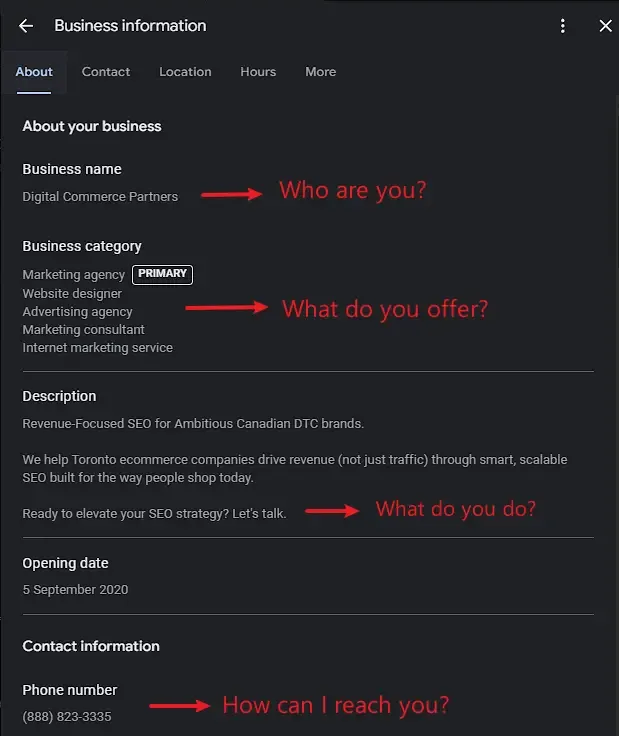
Google Business Profile (GBP) is one of the most popular and powerful tools for starting your local SEO journey. Think about it as a regular social profile: you need a name, short description about who you are, photos, and your contact information. Using this asset will help your business appear more prominently in local search results.
Beyond just appearing in searches, GBP provides valuable performance insights such as: tracking how customers find you and, how many people call your business, request directions, and visit your website. This data helps you understand what’s working so you can refine your local SEO approach over time.
Essential Elements for Optimizing Your Profile
While creating a GBP is quite simple, you should take care of the small details. Google’s guidelines are strict, and small mistakes can trigger penalties that may affect your local rankings. Here’s what you need to get right:
Business Information
Business description: Write a clear, benefit-driven description that explains what you do and what makes you different. Avoid keyword stuffing and include relevant keywords naturally. Focus on the tangible benefits you deliver and why you’re the right choice for your customers’ specific needs.
Categories: Select one primary category and up to two additional categories that are accurately related to your services and products. Choose categories based on what customers actually search for, not what sounds impressive. Your category selection directly impacts when and where your business appears in local results.
Business hours: Keep your operating hours accurate and update them for holidays, vacations, or special events. Nothing frustrates customers more than arriving to find you closed when Google said you’d be open.
Visual Content
Photos and videos: Share current, authentic images of your products, services, location, and team. Real photos build far more trust than generic stock images and give potential customers a genuine preview of what to expect.
Regular Updates and Activity
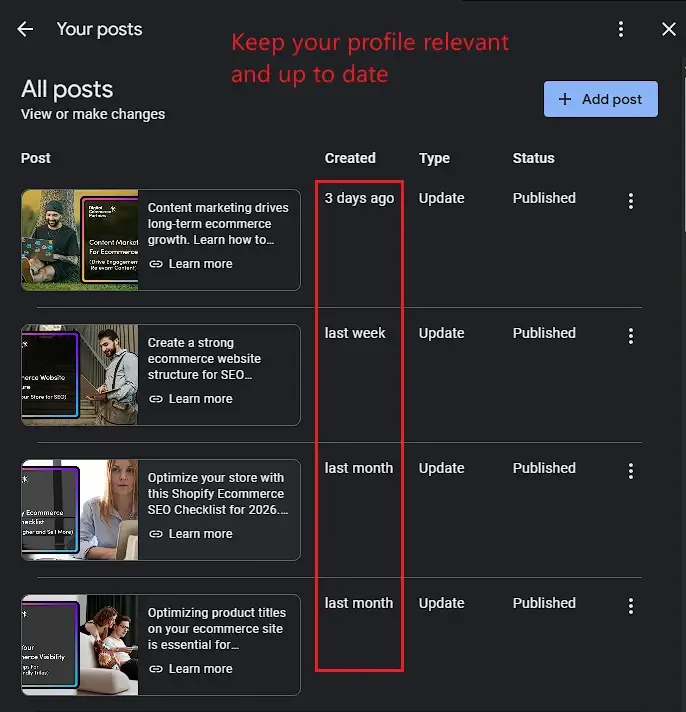
Google prioritizes profiles that demonstrate consistent activity, interpreting them as signals of dynamic, trustworthy businesses. Keeping your profile updated tells both Google and customers that your business is active and customer-focused.
Posts: Announce promotions, events, or industry news. These posts appear directly on your profile and can immediately capture attention from potential customers browsing local results.
Service updates: Keep your offerings current. Add new services, update pricing, or highlight seasonal options to reflect what you’re actually providing.
Content freshness: Set a regular posting schedule to maintain visibility in local searches. Consistent activity signals reliability and keeps your business top-of-mind.
Once you have these elements optimized, your GBP will be “good-looking” in Google’s eyes. However, it’s just as important to know what to avoid:
- Don’t stuff keywords into your business name: It’s tempting to add “Best Cafe Bar in Toronto” to your business name, but Google penalizes this manipulation. Your business name must match what appears on your website and signage exactly. I’ll explain why this consistency matters in the next section.
- Don’t select more than three categories: While Google allows up to nine categories, choosing more than three creates confusion about what your business actually offers. This dilutes your relevance for any single category and can hurt your rankings.
- Don’t post fake reviews: Google’s algorithms are sophisticated at detecting review manipulation. If you get caught paying for reviews or incentivizing positive ones, Google will delete them. In the worst case, you can lose your profile.
- Don’t ignore negative reviews: A bad review stings, but leaving it unanswered signals indifference. Responding shows you care about customer experience, and sometimes you can even resolve misunderstandings and turn critics into advocates.
Like traditional SEO, consistency is key. Consistent GBP activity directly impacts your visibility: businesses that keep their profiles updated appear more frequently in local pack results and maintain stronger rankings over time. For customers, an active profile builds immediate trust. Keep your profile active, monitor your performance, and adjust based on what the data tells you.
Check for NAP Consistency
Another critical factor for your GBP is maintaining NAP consistency (Name, Address, Phone). Google uses this data to verify your business’s legitimacy and trustworthiness. When it finds identical information across multiple sources (your website, social media profiles, local directories, and GBP) it interprets your business as authentic and rewards it with greater visibility in local search results.
Best Practices for NAP Consistency:
- Standardize your format: Choose one way to write your business name, address, and phone number, then use it everywhere, no exceptions.
- Match your physical signage: Your GBP name should match what appears on your storefront, business cards, and official documents, not an idealized or keyword-stuffed version.
- Update everywhere simultaneously: When you move locations, change phone numbers, or rebrand, update all your online listings at once to avoid temporary inconsistencies.
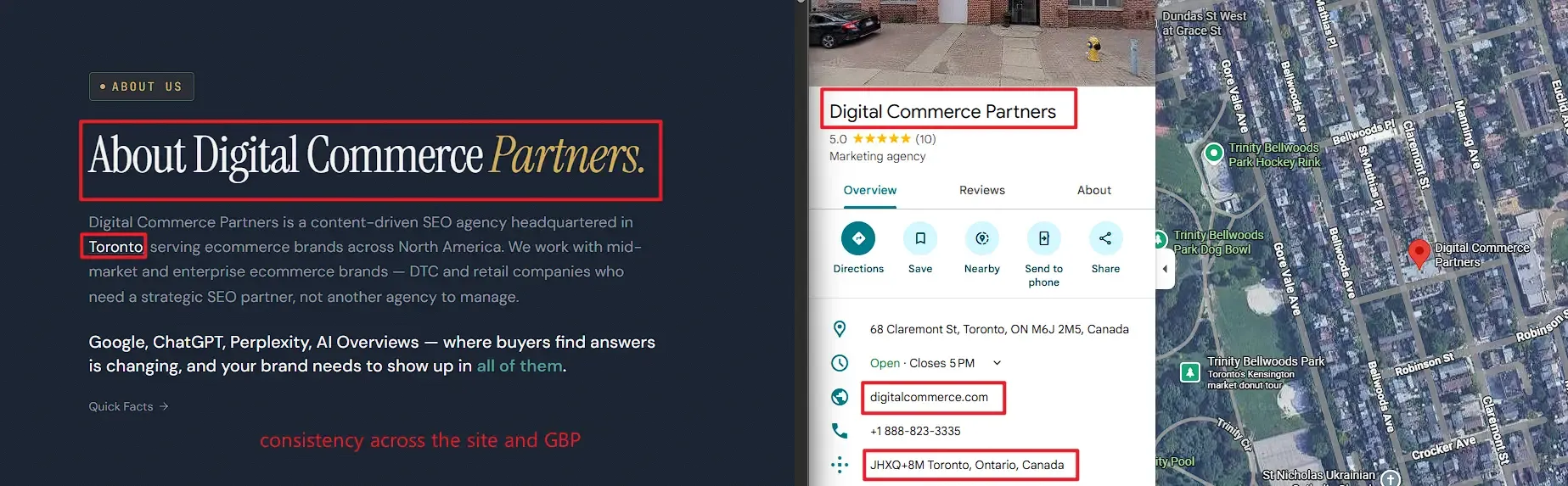
Maintaining NAP consistency is one of the simplest yet most impactful local SEO practices. It requires minimal effort but significantly strengthens Google’s confidence in your business information.
For customers, consistent information means they can actually reach you without frustration. Wrong phone numbers or outdated addresses not only send potential customers straight to competitors, but also hurt your local authority score and your chances of appearing in the Local 3-Pack. In competitive local markets where multiple businesses aim for the same searches, NAP consistency often determines who appears in the top positions and who gets buried on page two.
Encourage Reviews
Customer reviews are one of the most influential factors in a potential buyer’s decision: according to BrightLocal, 83% of people use Google to find reviews of local business.They act as powerful social proof, building trust and reducing uncertainty when choosing a business. But reviews are also a critical ranking signal for Google. Positive reviews, review volume, and your responsiveness all directly impact your local search rankings and GBP visibility.
There are different effective and organic ways to encourage your customers to leave reviews:
- Post-purchase email campaigns: Send follow-up emails after a purchase or service is completed, thanking customers and including a direct link to your GBP. Keep the message brief and make leaving a review as frictionless as possible.
- QR codes at your location: Place visible QR codes at checkout counters, waiting areas, or reception desks so customers can quickly scan and leave a review from their phones while their experience is still fresh.
- Website CTAs and review widgets: Add natural calls to action on thank-you pages, in your footer, or through review widgets that invite satisfied customers to share their experience without disrupting the user journey.
As I mentioned before, responding to reviews, both positive and negative, signals to Google and potential customers that you’re an engaged, customer-focused business. Thank customers for positive reviews to reinforce loyalty.
For negative reviews, respond professionally, acknowledge the issue, and offer solutions. When potential customers see you actively engaging with feedback, you build trust. This visibility in how you handle feedback becomes a decisive trust signal that influences the final click-to-call or visit decision.
Rank Local Keywords
Just like traditional SEO, keyword research is a fundamental pillar of your local positioning strategy. Conducting thorough local keyword research reveals what terms your competitors are targeting, which opportunities they’re missing, and how you can gain a competitive edge. The difference with local SEO is that you’re also looking for keywords with local intent that signal someone is ready to visit, call, or buy nearby. Here are some effective approaches that have worked well for me.
Use Google Autocomplete
Google’s autocomplete feature is a powerful, free tool for discovering local keywords based on real user behaviour and geographic location. When you start typing a search query, Google suggests completions based on what people in your area are actually searching for, giving you direct insight into local search intent. Keywords vary significantly by location.
For example, if you’re in Toronto and type “best grass-fed meat delivery in,” autocomplete will prioritize suggestions for Toronto and surrounding areas. These suggestions show you what customers (located in the same area) are actually typing.
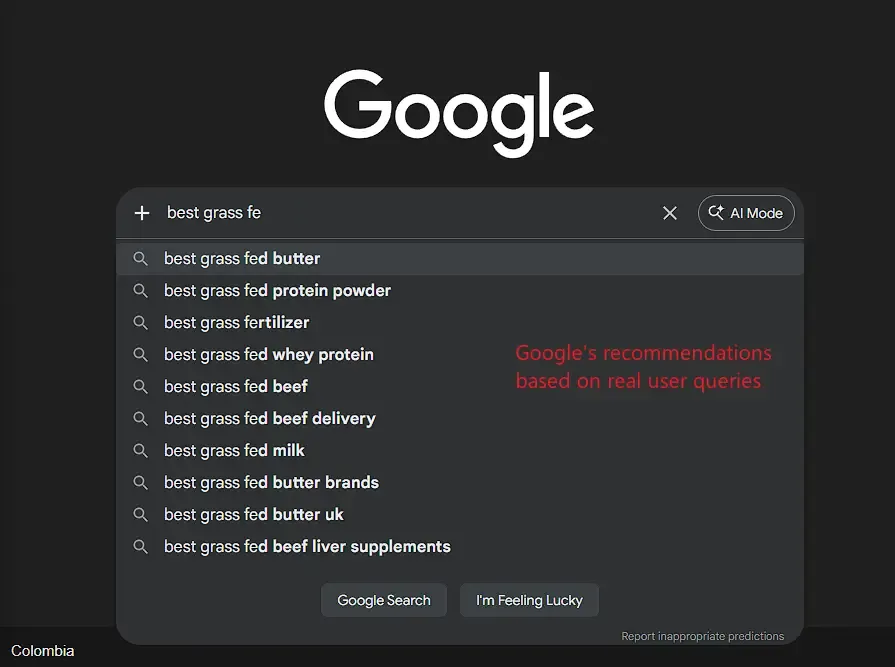
To implement this strategy, start with your core service or product. Let’s say, for example, you run a bicycle shop, type “bicycle shop” into Google and note the suggestions that appear.
Then add local modifiers like “bicycle shop in Toronto,” “bike stores downtown,” or “bicycle repairs near me” to discover more specific variations.
Try question-based queries, too: “where to buy,” “how to find,” “best place for.” These variations often reveal long-tail keywords with clear purchase intent.
Within 15-20 minutes, you’ll have a solid list of locally-relevant keywords that reflect customer search behaviour, and the best part: it’s free!
Review Your Competitors
One of the most efficient ways to discover valuable local keywords is by directly analyzing your main competitors. Instead of starting from scratch, you can identify which terms are generating traffic for similar businesses in your niche and take advantage of these opportunities.
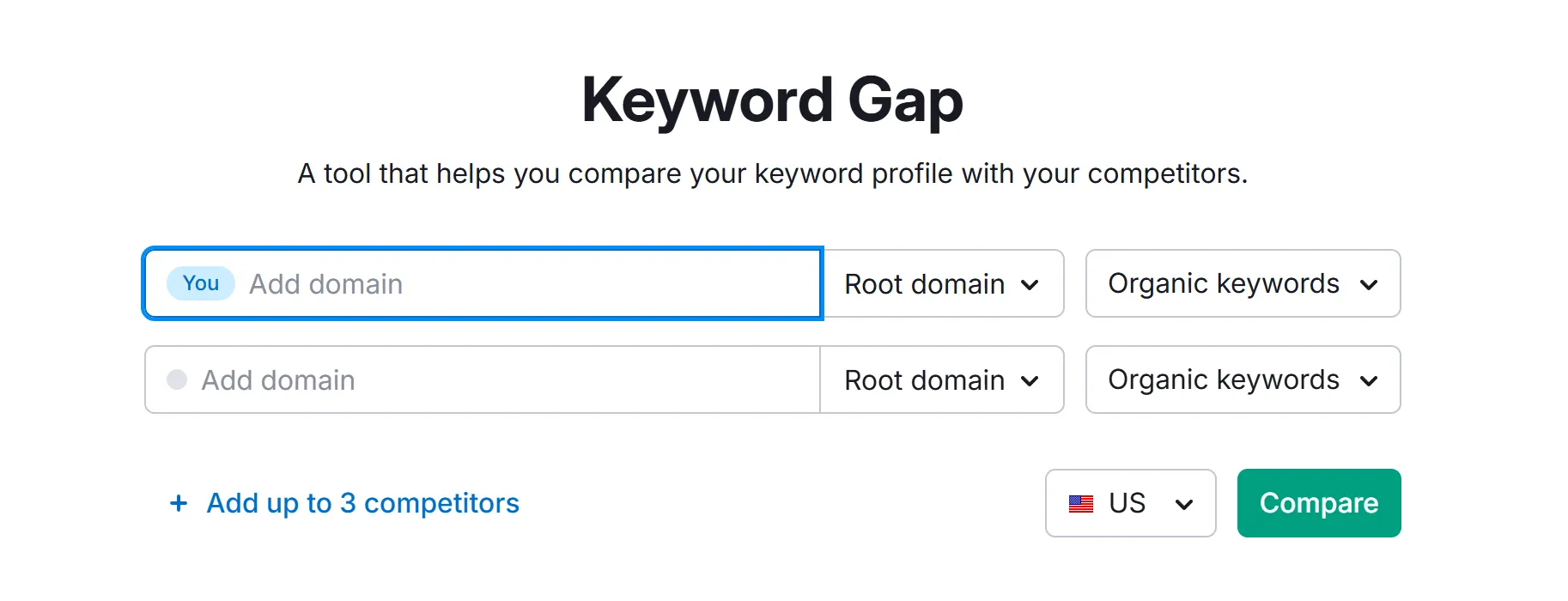
I like to use Semrush’s Keyword Gap tool to analyze competitors. It allows you to see exactly which keywords your competitors are ranking for. Here’s the step-by-step process:
- Enter your domain: Enter your website URL in the first field.
- Identify your competition: Make a list of 3-5 direct competitors that are ranking in your geographic area.
- Select your target country: Choose the geographic location relevant to your business.
- Compare: The tool will generate a comprehensive report.
- Filter by “Untapped”: Scroll down to the keyword table and select this option. You’ll see all the keywords for which at least one of your competitors is ranking, but you’re not. These are your immediate opportunities.
Once you have identified these keywords, you can refine your research using advanced filters to exclude irrelevant keywords, such as brand ones. You can also filter by:
- Volume: The average number of monthly searches. Prioritize words with enough volume to generate significant traffic.
- Keyword Difficulty: The level of difficulty to rank in the top positions.
- Intent: The general purpose of the search (transactional, commercial, navigational, or informational).
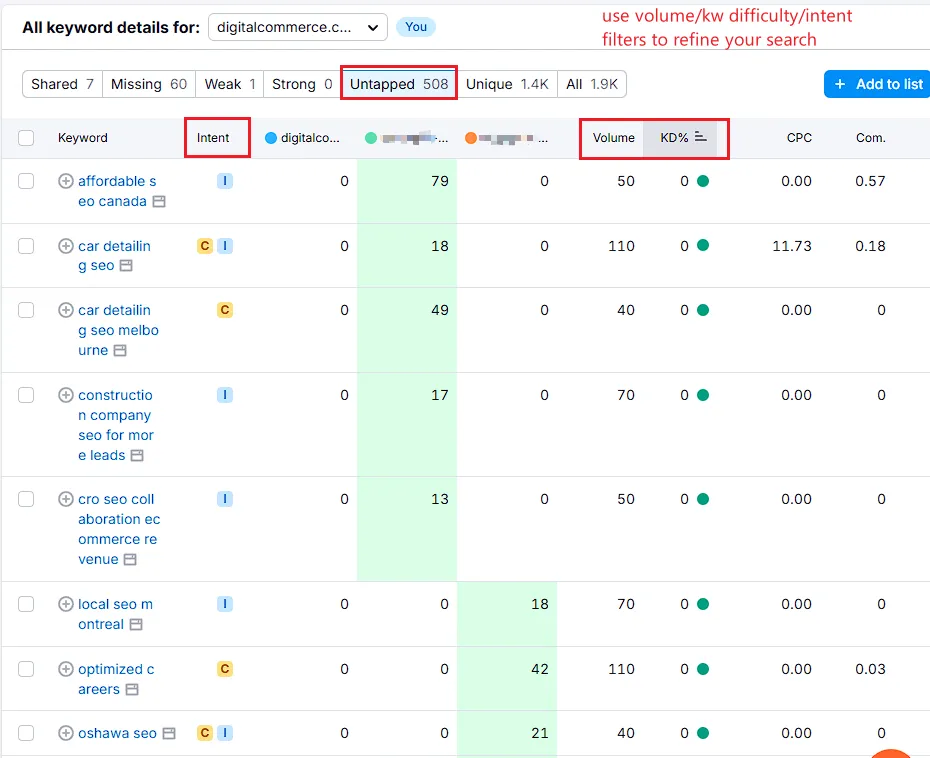
With your keywords identified and filtered by volume, difficulty, and intent, you can now export the results and prioritize implementation across your on-page content, metadata, and GBP.
Periodically conducting local keyword research using these strategies keeps you current with updates in your niche and reveals new opportunities to understand your audience better.
Google acknowledges businesses that demonstrate consistent relevance through quality content and up-to-date information. This ongoing optimization directly improves your local rankings because Google interprets regular content updates and keywords alignment as proof that your business is active, trustworthy, and genuinely valuable for local searches.
On-Page Optimization
Once you have identified your local keywords, it’s time to strategically implement them on your website in an organic and user-friendly way. On-page optimization for local SEO goes beyond simply adding local based keywords. It incorporates these terms in a way that makes sense to both users and search engines.
Key On-Page Optimization Strategies
-
Landing Pages Based on Location
Location-based landing pages are one of the most effective strategies for capturing qualified local traffic. The approach is straightforward: create dedicated pages for each city, region, or service area where you operate using the keywords you found in the previous step.
We tested this strategy with an ethically raised meat brand looking to expand its geographic reach, and the results proved the method works.
The Implementation
We created 29 specific landing pages for different cities, each optimized for searches such as “New York City’s Butcher Meat Delivery Service,” or “Texas’ Best Grass-Fed Meat Deliver.” The key was not just to create generic pages by simply changing the city name, so each page included:
- Local FAQs: Specific information about delivery areas, shipping times, and packaging details relevant to that city.
- Localized testimonials: Reviews and experiences from real customers in each region.
- Strategic internal links: Clear connections to its top-selling products and collections to facilitate conversion.
This structure drove qualified traffic directly to products that convert, and also reinforced the brand story. Users who arrived didn’t just find meat, they discovered a commitment to ethical agriculture, regenerative practices, and a transparent food system. You can find the complete case study here.
-
Metadata Optimization
Ensure each landing page includes optimized metadata that signals relevance to both search engines and local customers. Focus on:
-
Title tags that combine your primary keyword with location in 60 characters or less.
-
Meta descriptions that highlight your service and value proposition using local terms within 160 characters.
-
Headers (H1, H2, H3) that naturally incorporate local keyword variations throughout your content structure.
-
Alt text for images that includes relevant local context.
-
Clean URLs that feature both your service and location.
This metadata foundation helps search engines understand exactly what you offer and where you serve, making it easier for local customers to find you in search results and improving your click-through rates from search engine results pages.
More importantly, well crafted metadata directly influences click through rates (CTR). Higher CTRs signal relevance to Google, creating a positive feedback loop that improves your rankings over time.
-
Schema Markup
Implement LocalBusiness Schema markup to help Google and search engines better understand your local information. You can add these elements in your schema markup:
-
Business name
-
Full address (NAP)
-
Phone number with proper formatting
-
Hours of operation including special hours for holidays
-
Geographic service area with specific cities or radius
-
Detailed types of services offered
-
Business logo and images
-
Price range
-
Customer review ratings
-
Social media profiles
This structured data significantly improves your chances of appearing in rich snippets and Google’s Knowledge Panel, the information box that appears on the right side of search results for branded queries. Rich results stand out visually and typically generate higher click-through rates than standard listings.
Properly optimized on-page elements help Google understand your business and directly influence whether you appear in local searches, whether customers click your result over competitors, and whether those visitors convert. Businesses that implement these strategies consistently see benefits such as improved local pack rankings, higher website traffic from geo-targeted searches, and better conversion rates.
Start Optimizing Your Business for Local SEO
You’ve made it this far, which means you understand the importance of local SEO and are ready to implement it. But between optimizing your Google Business Profile, creating localized content, researching keywords, building location-specific landing pages, and keeping everything current, the work piles up fast.
Let us help you grow your business.
At Digital Commerce Partners, we work with ecommerce brands that have a physical presence, local shipping, or well-defined regional markets to build local SEO strategies that deliver measurable results. We’re not just talking about better rankings: our team can also net your business more qualified traffic, higher conversions, and tangible revenue growth.
Whether it’s local keyword research, managing your GBP, or building landing pages that speak to your community, we handle the heavy lifting so you can focus on growing your business.
Check out our Local SEO services or book a call today to see how we can help your business dominate your local market.