
Table of Contents
2025 was a wildly volatile year for search. But with volatility comes opportunity.
Here are a few things we accomplished:
- We grew organic revenue for a luxury sleepwear brand by 103% in 1 year.
- Ranked #1 for head terms like “sex toys,” “security camera,” and “custom t-shirts” for clients who’d been stuck on page two for years.
- Took a DTC electronics brand from 12K to 100K monthly organic visits in ten months – rebuilt their category architecture and targeted high-intent product keywords their competitors were ignoring.
These results came from understanding something most ecommerce SEO agencies miss: Direct-to-consumer (DTC) brands don’t operate like traditional retailers, and the SEO strategy shouldn’t either.
Direct-to-consumer brands face customer acquisition cost (CAC) pressure that retailers don’t. You need customers who come back, not one-time bargain hunters.
When someone Googles your brand name before buying, what they find on that first page shapes whether they convert.
Generic “more traffic” SEO doesn’t account for any of this.
At Digital Commerce Partners, we work with 15 DTC and ecommerce clients at a time. That’s it. This guide covers what we’ve learned about what actually works – and what to look for if you’re evaluating agencies.
Why DTC Brands Need Specialized SEO
Traditional ecommerce SEO optimizes thousands of category pages and product listings, chasing high-volume keywords where the biggest catalog wins.
Most DTC brands have smaller, curated catalogs. You’re competing on brand, quality, and customer experience – not selection.
That requires a different approach.
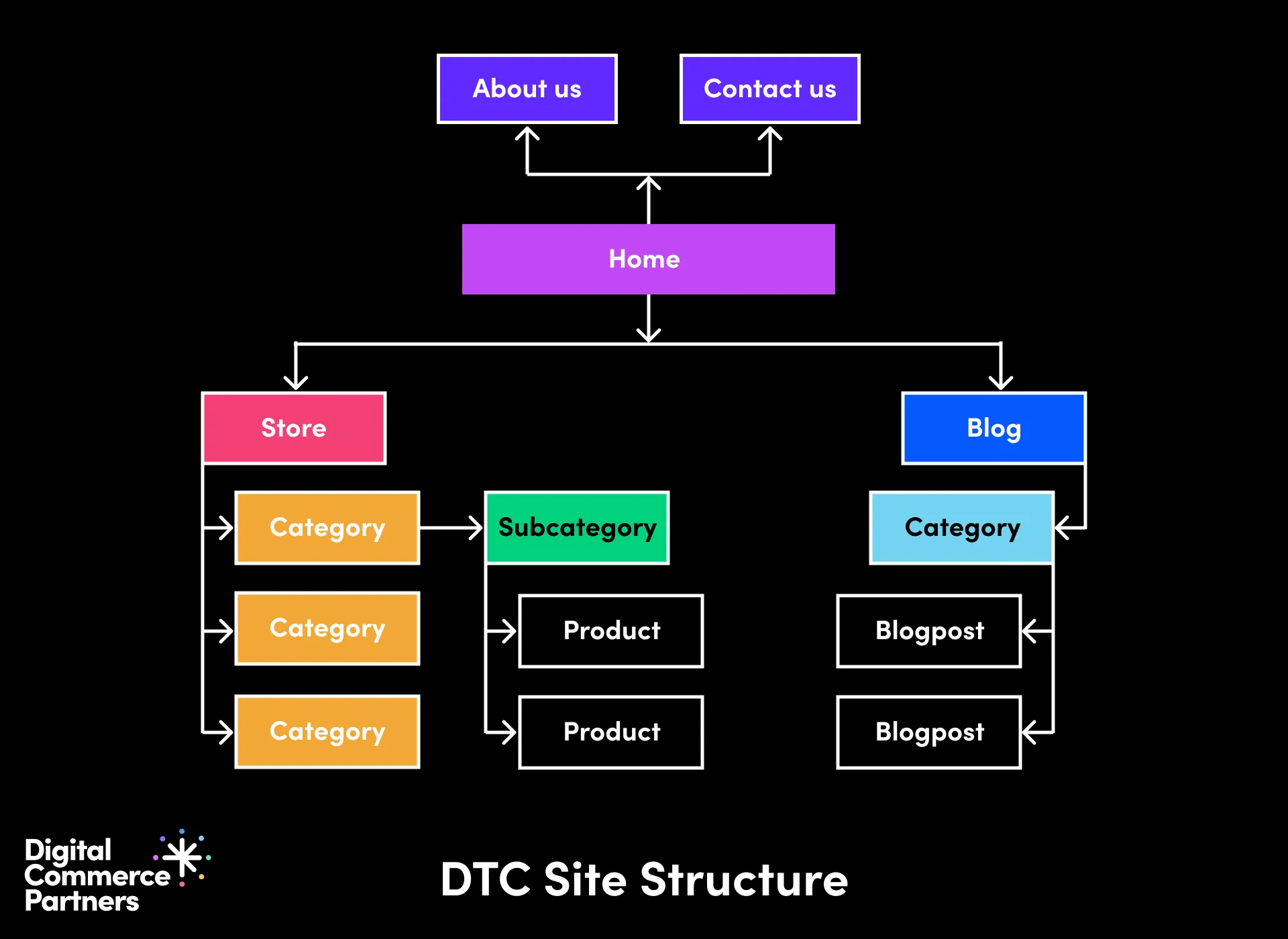 Example site structure for a DTC brand - Shows internal linking flow and breadcrumb navigation.
Content that builds brand, not just ranks
DTC brands live and die on brand affinity. Your organic content strategy needs to reinforce positioning and trust, not just capture keyword traffic that bounces.
We build content architecture around topical authority – establishing your brand as the answer in your category, not just another search result.
CAC economics
For most DTC brands, SEO isn’t about “free traffic” – it’s about reducing blended customer acquisition cost.
We target keywords where organic traffic converts and contributes to revenue. Impressions without purchases don’t move the needle.
LTV alignment
Not all traffic is equal. We prioritize keywords that attract repeat buyers (customers with high lifetime value) over one-time deal seekers.
For the sleepwear brand we mentioned, this meant focusing on collection pages for core products their best customers buy repeatedly, not just seasonal gift guides that attract one-and-done shoppers.
For a tactical breakdown, see our guide to D2C ecommerce SEO.
What to Look for in a DTC SEO Agency
After years of doing this work, we know what separates agencies that deliver from those that don’t.
When you’re evaluating partners, these are some things to look for – and some to avoid.
1. DTC-Specific Experience & Unit Economics
A brand selling through Amazon and a brand selling exclusively through Shopify Plus have fundamentally different SEO needs.
Ask whether they’ve worked with direct-to-consumer brands specifically – not just retailers or marketplaces.
They should understand your unit economics
A good DTC SEO agency asks about your CAC, LTV, and margin structure before proposing a strategy. If they don’t, they’re not thinking about how SEO fits into your business.
SEO strategy should align with unit economics.
Tight margins? Chasing competitive head terms with long payback periods might not make sense.
High LTV? Investing in content that captures early-stage buyers pays off over time.
Keyword strategy matches competitive position
We match keyword strategy to competitive position. Some agencies only chase long-tail keywords. Others waste retainers on head terms their clients will never rank for.
We do both – strategically.
For brands with strong domain authority, we win head terms. For emerging brands, we target longer-tail queries with clear purchase intent.
The difference is knowing which approach fits your competitive position.
Platform expertise compounds
If an agency has never worked in Shopify Plus, they’ll spend your retainer learning the platform’s SEO quirks instead of executing strategy. We specialize in Shopify and Shopify Plus because we’ve already solved most platform-specific challenges dozens of times.
Beyond standard platforms, we’ve rebuilt entire product taxonomies for custom ecommerce systems.
One air filter manufacturer hit a scaling wall because their custom platform couldn’t handle catalog growth – poor data architecture made it impossible to add products without creating SEO chaos. We rebuilt their taxonomy from scratch, created an automated categorization system, and delivered $233k in real revenue.
That kind of technical problem-solving requires deep platform expertise, not just template optimization.
Google Shopping can’t be an afterthought
If an agency doesn’t understand Google Merchant Center, feed optimization, and how Shopping rankings actually work, they’re ignoring where a huge chunk of your sales comes from.
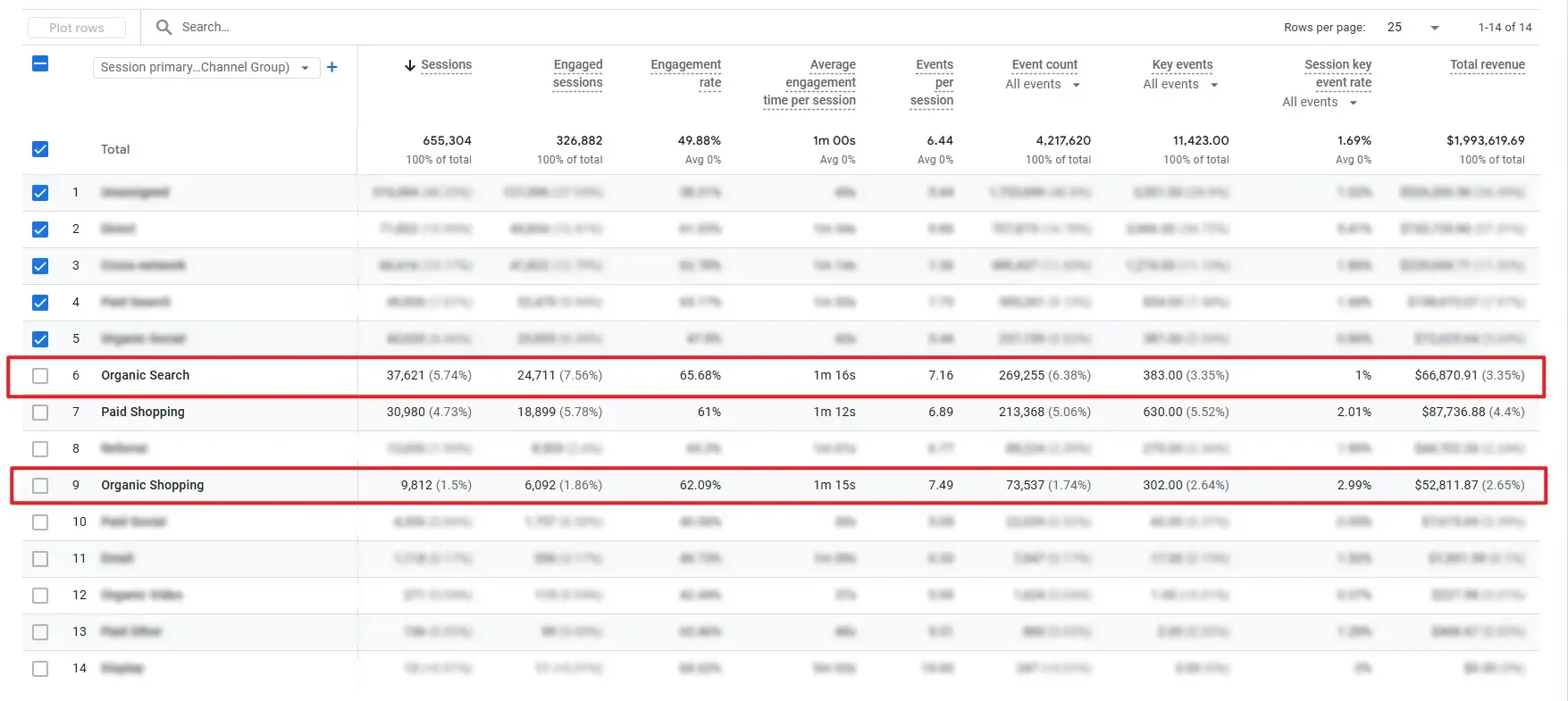 We’ve seen clients generate 2-3X more revenue per session from Organic Shopping compared to traditional organic search.
An electronics manufacturer went from $1.78 per session (organic search) to $5.38 per session (organic Shopping).
Feed optimization means correctly structuring product titles with high-intent keywords, using accurate Google product categories, submitting proper GTINs, and maintaining clean product data that doesn’t trigger disapproval.
For the complete breakdown of Shopping optimization, see our guide to Google Merchant Center for organic traffic.
2. Content Strategy That Builds Brand
DTC SEO isn’t just technical fixes and backlinks. It’s content that makes people trust you enough to buy.
Agencies should think beyond bottom-of-funnel keywords. Yes, you want to rank for product-intent searches. But DTC brands also need content that captures earlier-stage buyers, builds category authority, and reinforces positioning.
If an agency’s entire pitch is “we’ll optimize your PDPs and build links,” they’re missing the full picture.
We take the opposite approach: Category architecture first, content volume second. The content we do create earns trust and drives repeat purchases – not just rankings.
3. Revenue Attribution
“Traffic up 200%” means nothing if revenue is flat. Ask how they measure SEO’s contribution to revenue.
- Do they track organic revenue growth alongside rankings?
- Can they show how category page improvements translated to sales?
- Do they understand that a 50% traffic increase to high-converting pages beats a 200% increase to pages that don’t convert?
Our QBRs lead with revenue impact. Rankings and traffic are leading indicators, but organic revenue contribution is the metric we optimize for.
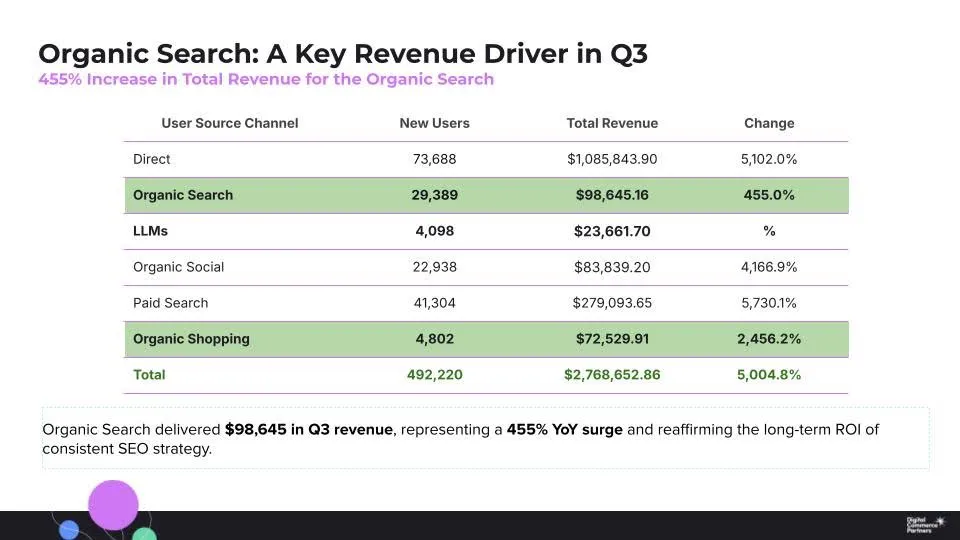 Organic Google Shopping and LLM traffic are significant sources of high-purchase intent traffic.
When we expanded collection pages for the sleepwear brand, the Pajama Sets collection saw organic revenue share grow from 14% to 27%. That’s what we report on.
4. Forward-Looking on AI Search
AI search is already here. ChatGPT, Perplexity, and Google’s AI Overviews are driving real traffic (and real revenue) for DTC brands. This isn’t a future consideration; it’s happening now.
- Ask if they’re tracking LLM visibility.
- Ask if they know how to optimize for it.
- Ask if they know where your brand is ghost-ranked — cited by AI but not recommended.
Most agencies aren’t even measuring this yet. We are – and we’re already seeing DTC brands pick up incremental revenue from AI-driven search.
For a tactical checklist to evaluate your current SEO foundation, see our ecommerce SEO checklist.
How We Approach DTC SEO at Digital Commerce Partners
We built DCP around DTC and ecommerce brands. That focus shapes everything.
Category architecture first
Most agencies pitch “we’ll create X blog posts per month.” That’s backwards for ecommerce.
We start with category page strategy – building out the page structure that captures purchase-intent searches. Subcategories, collection pages, filtered views. These pages rank for keywords where someone’s ready to buy. Content supports that architecture.
Strategic keyword targeting
Some agencies only chase long-tail keywords. Others waste retainers on head terms their clients will never rank for. We do both – strategically.
For brands with strong domain authority, we win head terms. For emerging brands, we target longer-tail queries with clear purchase intent. The difference is knowing which approach fits your competitive position.
Revenue as the primary metric
Traffic dashboards don’t pay the bills. Our QBRs lead with revenue impact because that’s what matters to your business.
Platform expertise
If an agency doesn’t know Shopify’s SEO quirks, they’ll waste months on fixes that don’t work or miss opportunities the platform enables. We specialize in Shopify and Shopify Plus because platform expertise compounds—we’ve solved most challenges already.
AI search & GEO
We’re already tracking and optimizing for LLM visibility. This isn’t theoretical—we’re seeing DTC brands pick up revenue from AI-driven search.
Learn about our GEO services →
“DCP is the only SEO shop I’ll recommend to DTC ecommerce brands running Shopify.” — Nick Eubanks, VP of Owned Media, Semrush
Full methodology breakdown: Ecommerce SEO services.
DTC SEO in Action: Scaling a Premium Sleepwear Brand
A luxury sleepwear brand came to us with a common DTC problem: strong brand, devoted customers, invisible in organic search. They were missing 73% of pajama-related searches.
What we did: Identified gaps between their product offering and what customers were searching for. Used search data and seasonal demand trends to expand and optimize key collection pages—Pajama Sets, Nightgowns, Robes. Rebuilt site structure to showcase these collections more effectively.
Results: 103% organic search revenue growth year-over-year. 6,000+ new keyword rankings in one quarter. Pajama Sets collection organic revenue share grew from 14% to 27%. Organic’s share of total site revenue went from 36% in 2023 to 54% in 2024.
Collection expansion and category strategy drove results that compounded. Read the full case study →
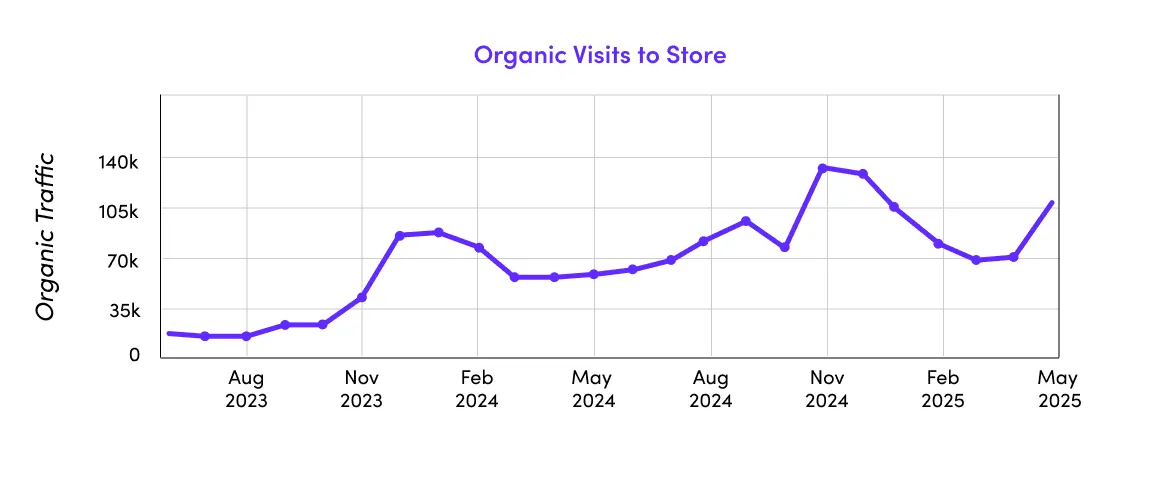 Our collection expansion strategy allowed the client to tap into keywords their customers already searched for, but had nowhere to land on their website.
Frequently Asked Questions
How much does DTC SEO cost?
DTC SEO services typically range from $5K–$15K per month, depending on scope and competitive intensity.
At DCP, we work with profitable DTC brands on retainers starting in the mid-four figures. The better question: what’s the return? A well-executed SEO strategy pays for itself through reduced blended CAC and compounding organic revenue.
How long until we see results?
Most DTC brands see measurable ranking improvements in 3–4 months and meaningful revenue impact in 6–9 months.
SEO takes time because Google needs to crawl changes, index new pages, and observe user behavior signals before adjusting rankings. But once you start winning positions, those rankings grow – new pages build authority faster, category expansions build on existing trust. Brands with strong existing domain authority and clear category opportunities move fastest.
For more details, read our article: How Long Does It Take to See Results From SEO Work?
Do you work with Shopify Plus?
Yes. Most of our DTC clients run Shopify or Shopify Plus. We also work with brands on BigCommerce, WooCommerce, and custom platforms.
Shopify Plus is our specialty – we’ve solved most platform-specific SEO challenges already.
Learn about our Shopify SEO services.
What’s the difference between DTC SEO and regular ecommerce SEO?
Traditional ecommerce SEO focuses on large catalog optimization and category rankings – Amazon, big-box retailers with thousands of SKUs.
DTC SEO requires greater emphasis on brand building, a content strategy that reinforces positioning, and alignment of organic traffic with customer acquisition economics. You’re not just ranking; you’re attracting customers who’ll buy again.
Do you offer audits?
Yes. We start most engagements with a paid audit that identifies the highest-impact opportunities for your brand and competitive set. It’s the fastest way to see where you stand and what’s worth prioritizing.
Learn about our ecommerce SEO audits →
What questions should I ask during an agency consultation?
Ask about unit economics first: “How does SEO strategy change based on my CAC and LTV?” If they can’t answer, they don’t understand DTC.
Ask for category page examples from past clients – not just traffic charts, but actual pages they’ve built and optimized.
Ask how they measure revenue attribution, not just rankings.
Ask what platform-specific challenges they’ve solved on your ecommerce platform. And ask what their client capacity is – agencies juggling 50+ clients can’t give you strategic attention.
What red flags should I watch for when vetting agencies?
Guarantees of specific rankings or timeline promises (“We’ll get you to page one in 30 days”). SEO doesn’t work that way.
Proposals that lead with content volume instead of strategy. Agencies that can’t explain how they’ve worked with brands in your competitive position. Case studies with traffic growth but no revenue data. And anyone who dismisses technical SEO or treats Google Shopping as someone else’s problem – for DTC brands, both are revenue drivers.
Ready to Talk?
Fifteen clients at a time. All DTC and ecommerce. All focused on revenue.
If you’re a profitable DTC brand looking for an SEO partner who understands your business – and can show you what’s possible with organic search – let’s talk.